

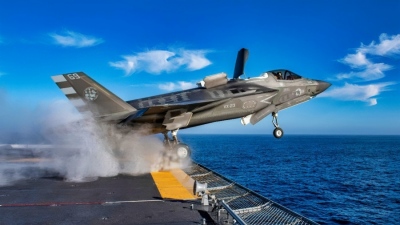
Sensitive technology from the F-35 fighter jet was unexpectedly funneled to Hong Kong this summer, triggering a red alert at the Pentagon and raising the prospect of China gaining access to critical components of the top-secret weapons system, as revealed by Politico on September 18.
Specifically, a shipment of F-35 parts destined for the US for repairs mysteriously diverted while traversing the Pacific Ocean from Australia, according to three people familiar with the matter who were granted anonymity to discuss private conversations.
The Pentagon confirmed the disappearance of certain components.
The parts, which were being transported by an intermediary on behalf of F-35 manufacturer Lockheed Martin, ended up instead in Hong Kong.
It is not clear why the equipment changed course or who has it in their possession now.
Unprecedented alert at the Pentagon over leak of classified technologies
The incident, which has not been previously reported, triggered a series of continuous briefings for congressional staff on key national security committees.
Officials from the State Department and the Pentagon first briefed staff in June, according to the same individuals, while multiple additional briefings are expected in the coming weeks.

The shipment included one of the aircraft's canopies, which covers the cockpit and contains stealth technology to which only the US and its allies have access, according to two of the individuals.
An adversary could study the components and potentially reverse-engineer the coveted technology if they possessed one of the canopies.
The Pentagon's F-35 Joint Program Office stated in an announcement that it «is aware of a shipment issue involving non-operational F-35 Lightning II parts».
How the... cargo of the century ended up in Hong Kong
The office is cooperating with US authorities and industry partners «to recover these components, investigate the incident, and establish safeguards to prevent a future recurrence», it added.
The unexpected diversion of the shipment toward Hong Kong, a special administrative region of China, would bring it into the sphere of influence of Beijing.
China has intensified its control over the city in recent years and has enacted increasingly strict national security laws that allow Chinese authorities to influence the island's authorities more and more.
«Critical elements in Chinese hands»
After all, China is already accused by the US of «extensive espionage against secret Pentagon programs», including the F-35.
«It is no secret that China aggressively attempts to acquire data on the F-35 through electronic espionage, among other means», stated J.J. Gertler, former staff member of the House Armed Services Committee and military aviation analyst for the Congressional Research Service.

«However, even if they already had specifications or other data on the component, possessing an actual one can give them even more evidence to proceed and can verify or refine what they had already learned».
The F-35 supply chain is a vast, global operational endeavor relying on facilities across multiple countries to transport and repair parts.
And while Australian maintenance depots exist for the fighter, none is yet capable of repairing... canopies.
What Lockheed Martin maintains
The manufacturer of the F-35, Lockheed Martin, manages the overall supply chain of the program and utilizes commercial freight carriers to move components.

Lockheed Martin stated that it could not discuss the status of shipments for security reasons, but adheres to all US regulations for shipping aircraft parts.
«Our teams manage every shipment with the utmost diligence and safeguards to ensure the integrity of the F-35 program and the security of our allied partners», it stated.
Which component is under the microscope and why it connects to stealth technologies
The canopy, a critical component of the F-35's stealth capabilities, is an acrylic bubble covering the cockpit that is coated with a thin layer of transparent radar-absorbent material helping conceal the aircraft from enemy radar.
According to the description by the US Air Force itself, this layer of stealth protection can degrade over time, prompting the repair or replacement of canopies among the more than 1,300 fighter aircraft produced for the US and its allies.
The State Department declined to comment.
Meanwhile, the Chinese Embassy stated that it was not familiar with the incident.
The F-35 program, which includes the US and other nations such as the United Kingdom, Australia, Denmark, Norway, and Poland, possesses a unique method of managing the flow of aircraft components.
Participating countries have access to a shared pool of spare parts stored across the globe, which belong to the US Department of Defense until the components are installed on the fighter aircraft.
www.bankingnews.gr








Σχόλια αναγνωστών